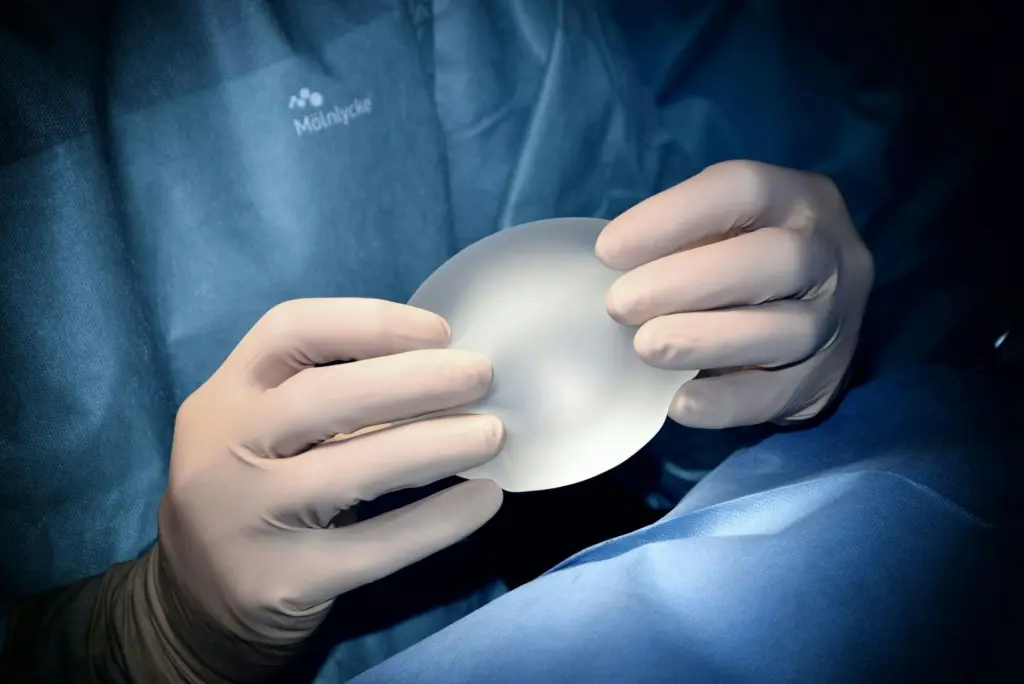
Choosing between teardrop and round implants comes down to three things: the shape you want, the risks you’re prepared for, and your own anatomy. Here’s what separates them.
A teardrop breast implant, also called an anatomical implant, is shaped to copy the slope from collarbone to nipple: volume held low, tapering towards the top. A round implant spreads its volume evenly in every direction. That one difference changes where fullness sits and how the breast reads from the side.
Teardrop implants may suit people who want a gentle upper slope with fullness concentrated lower down, particularly where there’s little natural breast tissue to create that shape. Whether they suit you comes down to your anatomy and goals, and that’s what a consultation is for.
What Are Teardrop Breast Implants?
Teardrop implants are silicone gel implants with a shaped shell, designed to hold their form once they are in the breast. That is why they use firmer gel, and why they carry a risk round implants don’t: rotation. Both are covered below.
Anatomical Design and Structure
The shape only works if the implant can hold it. Teardrop implants are filled with highly cohesive silicone gel, the firm, form-stable type nicknamed gummy bear gel. It keeps its form even if the shell is compromised, and it stops the implant slumping into a rounded shape once you’re upright.
Each teardrop implant also comes in a choice of profiles, usually low, moderate or high. Profile is how far the implant projects forward relative to its base width, and your surgeon uses it to match the implant to your chest width and the tissue available to cover it. Two people can have the same volume in cubic centimetres and look entirely different, because one has a wider, flatter implant and the other a narrower one that projects further.
What Are Round Implants?
Round implants are the shape most people picture when they think of breast implants. They spread volume evenly in every direction, so they give more fullness at the top of the breast and a more obvious cleavage. Because they are symmetrical, they look the same whichever way they sit, so there is no rotation risk to plan around. They are usually softer to the touch than teardrop implants, and smooth shells are widely used.
Teardrop vs Round Implants: How They Compare
Some newer implants blur the line. Certain round implants use a gel designed to shift under gravity, so the breast takes on a teardrop-like profile when you stand. They’re softer and less form-stable than a true teardrop implant, so your own tissue does more of the shaping.
Do Teardrop Implants Look and Feel More Natural?
Not automatically. Teardrop results can be hard to tell apart from round ones. A round implant can look just as natural when there’s enough of your own tissue to drape over it. Usually, tissue coverage is what decides it.
Appearance and Silhouette
The practical difference is where the eye lands. A teardrop implant creates a gradual slope from the upper chest into a fuller lower curve. A round implant gives more upper-pole fullness and more obvious cleavage. Neither is better. They’re different silhouettes, and the right one is the one you want.
If you’re starting with very little breast tissue and want a result that’s hard to identify as an augmentation, the teardrop shape gets you there more easily. With more tissue, your breast drapes over a round implant and softens it, and the shape underneath matters less than you’d think.
What makes an implant noticeable is rarely its shape. It’s size relative to your frame, how much tissue covers it, and whether it sits above or below the muscle.
Texture and Feel
Handled outside the body, a teardrop implant feels firmer than a round one because of its more cohesive gel. That difference is real. Once the implant is placed, particularly under the muscle, the gap narrows considerably and most people describe both types as soft. The firmness you can feel on a consultation room table is not the firmness of the finished breast.
Saline implants are a different matter. They can feel firmer than silicone and show more visible rippling, especially where breast tissue is thin.
Teardrop Implants Before and After: What to Expect
The teardrop result shows most clearly in side-profile photographs: a straighter line from collarbone to nipple, with a fuller curve beneath. From the front, teardrop and round implants of similar size can look surprisingly alike.
Size is chosen in cubic centimetres and matched to your chest width and tissue. Cup sizes vary too much between bra brands to plan surgery with, so a cup size on a label is a poor guide to what you’ll get.
Results also keep changing for months. Implants sit high and tight at first, then settle as swelling resolves and the chest muscle relaxes, a process usually called drop and fluff. Judging your result at two weeks is judging it too early.
Rotation, Rupture and Other Risks
Every breast augmentation carries the usual surgical risks, including infection, bleeding and asymmetry. Teardrop implants add one that round implants don’t.
Rotation
A round implant looks the same however it turns. A teardrop implant doesn’t. If it rotates, fullness meant for the lower breast shifts to the side and distorts the shape.
Rotation is uncommon, and most cases appear in the first year. You’d notice it as a change in shape, with fullness sitting to the side or high on the chest. It isn’t usually painful.
Rotation tends to happen when the pocket is slightly too large for the implant, or when early movement disturbs the tissue before it has settled around the shell. It can also happen later, after an injury or significant weight change. Correcting it means a further procedure, usually smaller than the original, to reposition the implant and tighten the pocket, or to swap it for a round one.
Rupture and Long-Term Monitoring
No breast implant lasts a lifetime, and the longer implants stay in, the more likely they are to need removing or replacing. That still doesn’t mean replacing them on a fixed schedule.
Older, more liquid silicone gels could escape into surrounding tissue when a shell tore. The highly cohesive gel in a teardrop implant holds its form, so a rupture tends to stay contained within the scar tissue capsule. The catch is that a contained rupture often causes no symptoms at all.
That’s why imaging matters. An ultrasound or MRI can check whether an implant has ruptured, and how often you have one is something to plan with your surgeon.
Capsular Contracture, BIA-ALCL and Breast Implant Illness
Your body forms a capsule of scar tissue around any implant. That’s normal. Capsular contracture is when the capsule tightens, making the breast feel firm, look distorted or become painful. It’s one of the most common complications of breast augmentation and a leading reason for further surgery.
BIA-ALCL (breast implant-associated anaplastic large cell lymphoma) is a rare cancer of the immune system linked to certain textured implant surfaces, not to the teardrop shape itself. Cases remain rare against the number of implants placed. See your surgeon if you notice persistent swelling, a fluid collection or a lump around an implant.
Some people with implants report a cluster of systemic symptoms often called breast implant illness. It hasn’t been established that implants cause these symptoms, and nothing suggests implant shape plays a part.
Safety and Regulation in the UK
Breast implants are Class III medical devices, the highest-risk category, regulated in the UK by the Medicines and Healthcare products Regulatory Agency (MHRA). To be sold here, they must carry a UKCA or CE mark.
Implant surfaces have changed in recent years. Textured shells were long standard on teardrop implants because tissue grips them and holds the implant in position. In 2019, Allergan withdrew its macrotextured BIOCELL range worldwide, including some teardrop models, over the BIA-ALCL association. Teardrop implants on the UK market today include microtextured, nanotextured and polyurethane-coated options, so it’s worth asking exactly which implant and surface you’re being offered, and why.
If you already have BIOCELL implants and no symptoms, regulators haven’t recommended removing them. Some people choose revision anyway, alongside the other common reasons: rupture, capsular contracture, rotation, or a change of mind about size or shape.
Keep a record of your implant. The Breast and Cosmetic Implant Registry covers England, Scotland and Northern Ireland, and your provider can register your implant with your consent. That makes a specific implant far easier to trace if a safety issue emerges years later.
Recovery Timeline
Recovery after teardrop augmentation follows the same timetable as round implants. The difference is how carefully the implant’s position is protected early on.
| Stage | What to expect |
|---|---|
| First one to two weeks | Time off work, rest and wound care. You’ll wear a support or compression garment for several weeks. |
| First month | No heavy lifting or strenuous exercise. Your surgeon may also restrict overhead stretching, underwired bras or certain sleeping positions while tissue settles around the implant. |
| Around six weeks | Most normal activities resume. |
| Following months | Swelling subsides and the implants drop into their final position. |
The early restrictions protect the pocket while the tissue sets, and they’re specific to your operation, so your own surgeon’s instructions take priority. Recovery shouldn’t be the deciding factor between shapes. That choice is about anatomy and the result you want.
Teardrop or Round: Which Is Right for You?
A teardrop implant may be worth discussing if you:
- want a gradual upper slope with fullness concentrated low
- have limited natural breast tissue, so the implant needs to supply most of the shape
- are comfortable with stricter early restrictions to protect the implant’s position
A round implant may be worth discussing if you:
- want more fullness at the top of the breast and a more defined cleavage
- have enough natural breast tissue to drape over the implant and soften its shape
- don’t want to plan around the risk of rotation
There’s no ideal age for implants. Candidacy rests on finished breast development, general health and your goals. Teardrop implants also generally cost more than round ones, because the shaped shell and highly cohesive gel are more complex to manufacture.
If You’d Prefer Not to Have an Implant
Fat transfer uses your own fat, harvested by liposuction, to add volume to the breast. It may suit people who want a more modest increase and have fat to spare, and it avoids an implant altogether, though some of the transferred fat is reabsorbed. Both routes can be discussed in the same consultation at our Harley Street clinic.
Book a Consultation at Botonics
At your breast augmentation consultation at our Harley Street clinic, we will assess your chest width, breast tissue and skin, and explain which option suits your anatomy and goals. You’ll get clear advice on the implant recommended, the risks involved, and what recovery looks like.
If you’d like to discuss your options, you can book a consultation with botonics at our Harley Street clinic.