
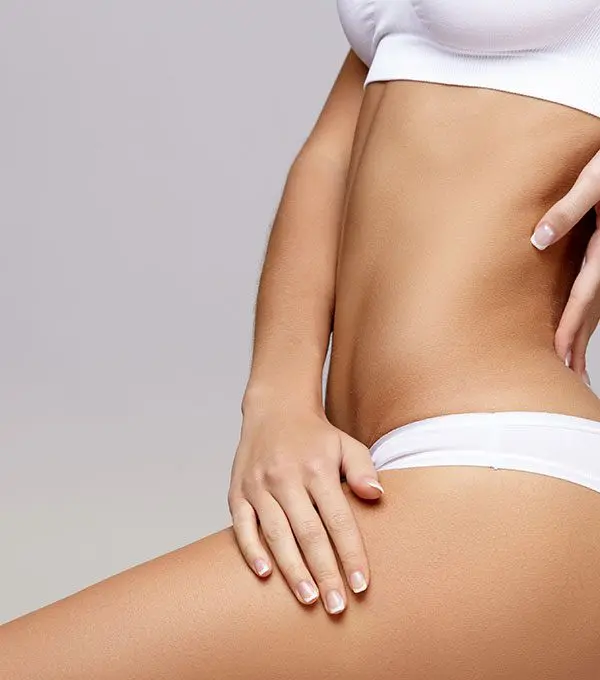
Fat transfer often comes down to a very specific question: can we take unwanted fat from one area and use it to add volume somewhere else, without introducing an implant? In the right patient, yes. Fat transfer, also known as fat grafting, takes fat from areas such as the abdomen, flanks, also known as love handles, or thighs and transfers it to areas including the breasts or buttocks.
At botonics, these procedures are carried out by Dr Katerina Charakida, MB BS, whose practice includes VASER liposuction, body contouring and fat transfer. Because the procedure reduces volume in the donor areas while adding it elsewhere, the dual-area effect can create quite a dramatic overall change.
Fat transfer works best when there is enough donor fat to produce a worthwhile result and the patient has realistic expectations about the amount of volume that can be added.
At the lower end, the limiting factor is usually donor volume. This matters particularly for buttock fat transfer, which generally requires more fat than a modest breast augmentation. At the higher end, the issue changes. More donor fat does not automatically make someone a better candidate, because overall health and the amount of liposuction required also affect whether surgery is appropriate.
What matters most is the combination of your health, weight stability, where your fat is stored and how much can be removed safely while leaving the donor areas smooth. We assess all of that in person rather than making the decision from a BMI number alone.
Consultation
Your first appointment is with your specialist, who will assess your donor areas, discuss the result you have in mind, and confirm whether fat transfer is realistic for your body before you decide whether to proceed. If you’d like to go ahead, your procedure is usually booked within around three weeks.
Fat Harvesting
Most procedures are performed under local anaesthetic as a day case. Larger procedures may require sedation or a general anaesthetic. Fat is removed from the agreed donor areas using VASER Lipo, which uses ultrasound energy to gently separate fat before it’s harvested.
The Transfer
The harvested fat is prepared and placed into the treatment area, whether that’s the breasts, buttocks or elsewhere. Smaller procedures can often be completed in under a couple of hours.
Going Home and Aftercare
You’ll be helped into your support garment and discharged when ready. Lymphatic aftercare begins the following day, and follow-up appointments are arranged to monitor your recovery.
You will return for follow-up a few weeks after treatment and again over the following months so we can monitor healing and assess how the final result is developing.
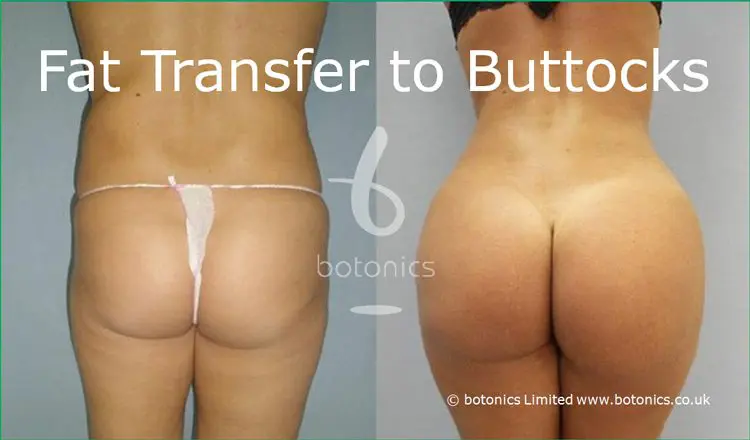
Vaser + Fat Transfer to Buttocks · Sedation
Butt Lift via Fat Transfer + Vaser · Local anaesthetic
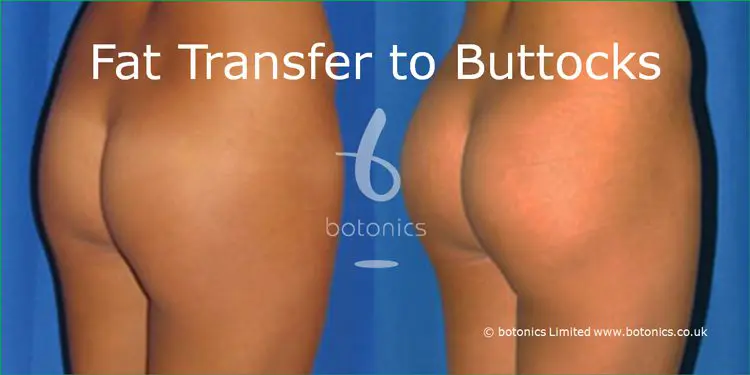
Butt Augmentation + Vaser · Local anaesthetic
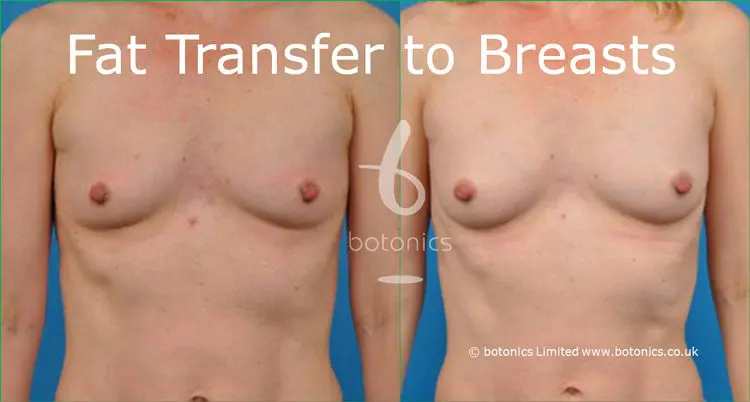
Fat Grafting to Breasts + Vaser · Local anaesthetic
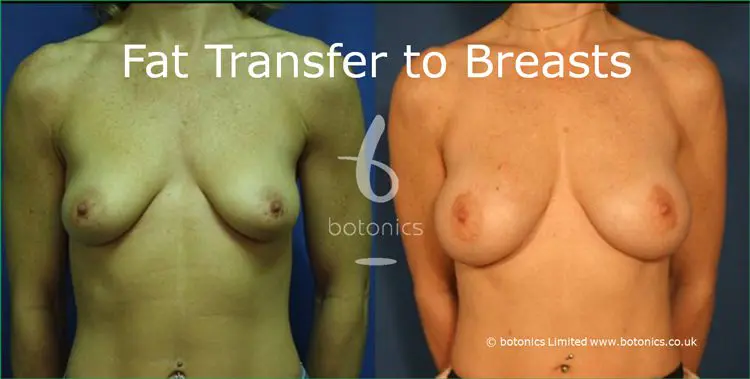
Fat Transfer to Breasts + Vaser · Sedation
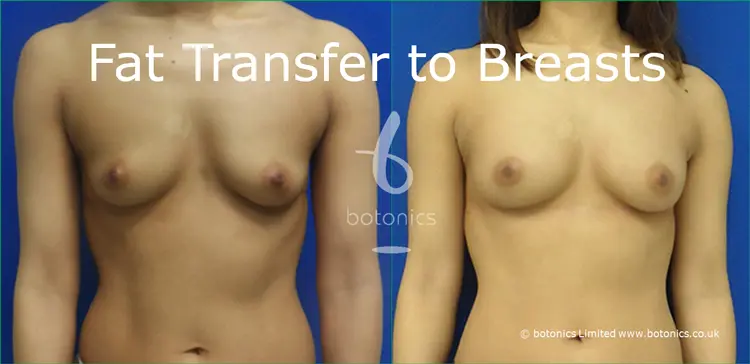
Fat Transfer Boob Job + Vaser · Local anaesthetic
View more Fat Transfer before and after case studies.
What patients say
Being in my early 20’s and suffering from asymmetrical breasts, I really struggled with my self confidence. I knew that I didn’t want implants and began to lose hope that I’d be…
Patient review
I had to work hard to find a good quality surgeon offering the Lipo Vaser + Fat transfer procedure. And I found one through Botonics who offered a second advantage. They were…
Patient review
I am very happy with the professional care I received at Botonics clinic. Customer servise over the phone was great and consultation with plastic surgeon was very professional . I wanted to…
Patient review
My experience with Dr Joffily and team is none other than first class(royal). I had a vaser fat transfer to buttocks. Consultantion with Bill was very proffessional and yet warm and very…
Patient review
I felt unhappy with myself for a lot of years now after having children putting on weight etc, so I decided To do something about it after reading all the good reviews…
Patient review
I live in Spain and researched my surgery options online. I was looking for a breast augmentation but a natural result, and a butt lift using vaser lipo. I found the Botonics…
Patient review
I've been self conscious for quiet a while I wanted something which would be affordable but does the job too. Finally! A friend recommended Botonics to me with a reasonable price it…
Patient review
Fat transfer is a surgical procedure, so understanding its limitations and risks matters just as much as understanding what it can achieve. These will be discussed with you before you decide whether to proceed.
Rated 5 out of 5 by 7 Fat Transfer (Fat Grafting) London patients Read all reviews
Treatment Summary
Procedure time
1 - 3 hours
Anaesthetic
Local, Sed or GA
Hospital stay
0 - 1
Sensitivity period
1 week
Back to work
1 week
Duration of results
Permanent
Risks & complications
Infection, bleeding, bruising, swelling, asymmetry, reabsorption of transferred fat.
Location
Your Specialist(s)
Next step
Ready to take the next step? Book a consultation at our Harley Street clinic to find out whether fat transfer is right for you. Your consultation will confirm the full cost based on our published pricing.
Book a ConsultationOr call +44 (0) 20 800 400 30
Common questions
Once transferred fat has survived and established a blood supply, it becomes a permanent part of the treated area. There is no implant to replace after a set number of years.
Some reabsorption is expected because not every fat cell survives harvesting and transfer. We allow for that when planning the procedure by placing additional fat initially, so the area will look fuller at first than it does once everything has settled.
Many patients have the harvesting and transfer completed in a single procedure. Whether one session gives you the result you want depends on how much donor fat is available, how much survives and the amount of volume you are hoping to add. This is discussed before treatment so expectations are clear from the outset.
Yes, in many cases. Smaller fat transfer procedures involving fewer areas can be performed under local anaesthetic as a day case. Larger procedures may be better suited to sedation or general anaesthetic.
You will see a change straight away, but the early appearance includes swelling and more fat than will ultimately remain. Over the following weeks and months, swelling reduces and the surviving transferred fat settles. The result is usually much clearer between three and six months after treatment.
Possibly. The number on the scale matters less than whether you have enough pinchable fat in suitable donor areas. Some slim patients still carry usable fat around the flanks or thighs, while others simply do not have enough to produce a worthwhile transfer. We check this physically at consultation.
A higher BMI can mean there is more fat available to harvest, but it does not automatically make fat transfer more suitable. We also need to consider your general health, weight stability, where the fat is stored and how much liposuction would be required. The fat stored deeper inside the abdomen cannot be harvested in the same way as the fat you can pinch beneath the skin, so the decision is made from an examination rather than a BMI number alone.
Most patients can return to desk-based work within about a week, but exercise takes longer. Strenuous activity and heavy lifting should be avoided during the first couple of weeks. Light exercise can then be introduced gradually from around weeks three to six, depending on how you are healing and which areas have been treated.
Sign up to our Newsletter receive regular updates

Explore Treatments
© botonics Plastic Surgery Group 2005 - 2026. All Rights Reserved.
Accreditations


